

How many levels does Japanese have and how are they divided?
- The most widely recognized system for measuring Japanese proficiency is the Japanese Language Proficiency Test (JLPT), also known as “Noken.”
- This exam has five levels ranging from the most basic to the most advanced: N5, N4, N3, N2 and N1.
- The N5 level represents the beginning of learning, while N1 certifies the highest command of the language.
- The “bridge” level between basic and advanced – that is, between N4/N5 and N2/N1 – is N3, designed for those who have already overcome the basics and seek to advance towards intermediate fluency.
Do you want to improve your Japanese level from home?
At Doki Doki Japan you will find online courses for all levels: from beginners to advanced, with live classes and materials designed to progress step by step.
JLPT (Japanese Language Proficiency Test) Exam Levels
Level N5: Basic understanding of the language
- It’s the entry level: it assesses whether you can understand simple phrases, everyday expressions, very basic kanji, hiragana, and katakana.
- On a practical level: you will be able to introduce yourself, ask simple questions and answers, understand basic instructions or cues, and handle very elementary interactions.
Level N4: Communication in everyday situations
- It is a step further: it involves additional vocabulary, grammar and kanji, capable of holding simple day-to-day conversations.
- With N4, you can understand simple texts, read simple announcements, instructions, or descriptions, and navigate routine situations with ease.
Level N3: transition to intermediate fluency
- N3 marks the barrier between basic knowledge and more flexible use of the language. It allows you to understand everyday texts with some complexity, announcements, simple news, and conversations at normal speed.
- It is ideal for those who want to live, study, or work in Japan but do not yet need a complete professional mastery.
Level N2: Advanced Text and Conversation Comprehension
- At this level, you are already expected to be able to read newspaper articles, texts with complex or specialized content, and understand fluent conversations, speeches, presentations, or work materials.
- N2 opens many doors to work, study, or socially integrate in Japan with significant autonomy.
Level N1: Full proficiency in the Japanese language
- It is the highest level of the JLPT. It is expected that those who pass it will understand a wide range of writings, from literature to abstract texts, opinion articles, technical documents; as well as speeches, conferences or complex conversations.
- With N1 you can function almost like a native speaker in formal, academic or professional contexts.
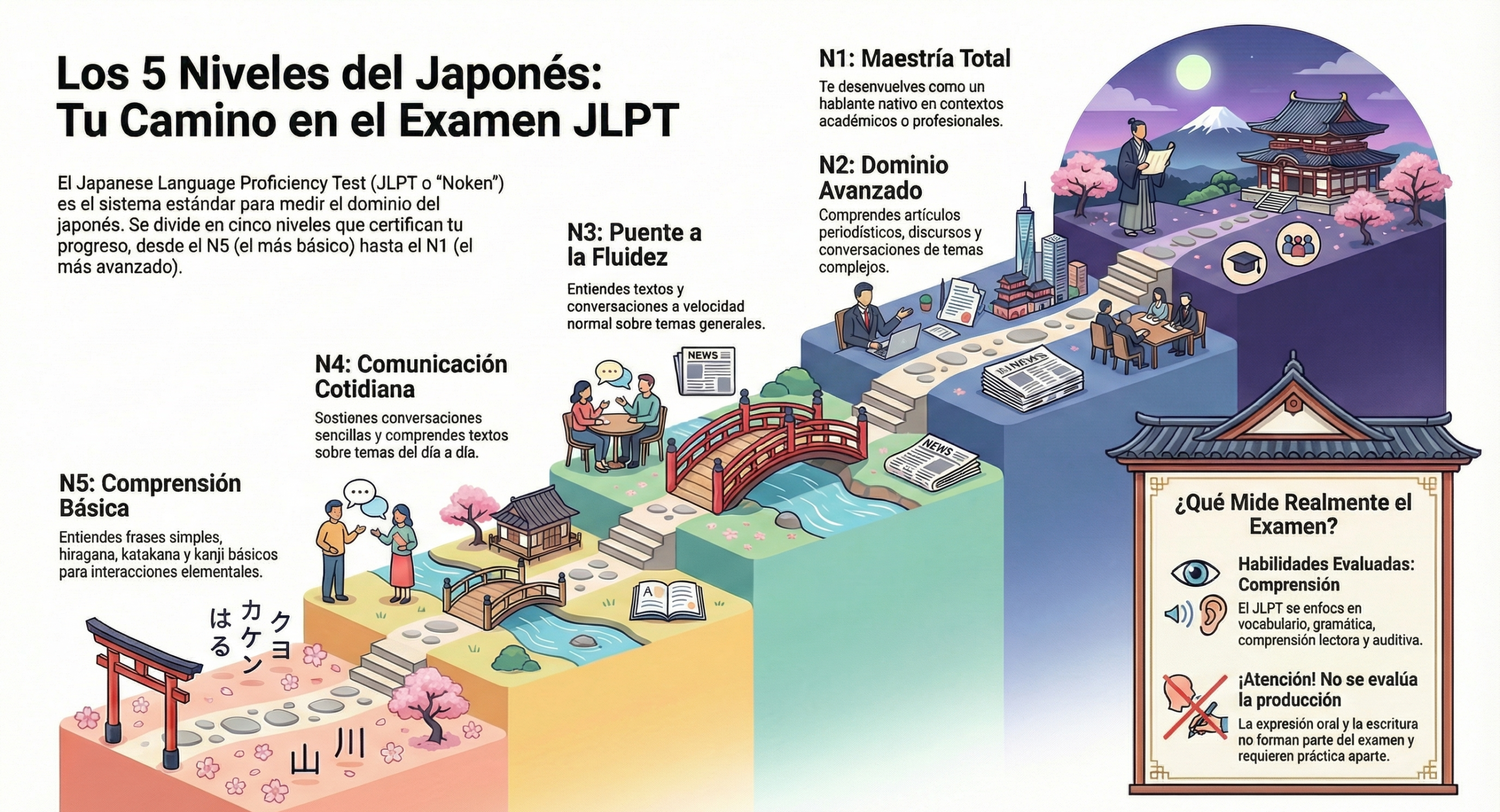
What is expected of you at each level of Japanese
To pass each level of the JLPT, the following skills will be mainly evaluated:
Vocabulary and grammar
As you level up, you’ll need to know more words, expressions, grammatical structures, and kanji. From the essentials in N5 to a wide and varied repertoire in N1.
Listening and reading comprehension
In the initial levels, the ability to understand simple phrases or slow sentences is assessed. With intermediate and advanced levels, comprehension of complex texts, articles, fluent conversations, media, etc. is required.
Oral and written production
Interestingly, the JLPT does not directly assess oral expression or written production: only reading, comprehension, vocabulary and grammar.
Therefore, if your goal is to speak fluently or write in Japanese, you should complement it with active practice, apart from the exam.
How to Prepare for Japanese Exams
Study Resources and Strategies
- Use specialized books and guides for each level—many schools and centers recommend starting with N5/N4-oriented materials if you’re just starting out.
- Practice reading, listening, and vocabulary on a daily basis: anime, manga, news, podcasts, music — it all helps to get used to the real rhythm of the language.
- Do mock exams, practice assessments, timed times — to familiarize yourself with the structure of the JLPT.
Recommended courses and platforms
- Studying with a structured course – like the ones we offer at Doki Doki Japan – helps a lot: planning, follow-up, personalized feedback.
- Complement with online resources: vocabulary apps, language exchange platforms, audio and reading platforms.
Learn Japanese online and reach your next level with Doki Doki Japan
If you’re thinking of moving your way with Japanese, the JLPT’s level system gives you a clear map. From the first steps (elementary level) to advanced mastery, each stage has its hits, challenges, and rewards. In Doki Doki Japan is ready to accompany you on that journey – with courses designed for beginners, intermediate and advanced, real learning strategies, personalized support and community.
Do you want us to put together a study plan based on your current level and your goals?

Co-founder and CEO of Doki Doki Japan. After studying Japanese in Japan between 2017 and 2019, he founded this school with the aim of offering accessible and authentic education to students who want to learn Japanese.


