

What is Bushido and what is its real meaning?
The concept behind the "way of the warrior"
The term Bushidō (武士道) literally translates to “the way of the warrior”: bushi (warrior) + dō (road). It is not simply a set of rules of engagement, but an ethical, moral, and spiritual code that defined the life of the samurai—a complete lifestyle that ranged from action on the battlefield to daily conduct.
Bushidō proposed that a warrior should be prepared for death, accept his fate, but without losing his humanity, his honor or his dignity. That acceptance of risk and mortality was integral to their training and way of life.
The key value of the omotenashi is mindfulness of the other: anticipating their needs, taking care of details, acting sincerely and without expecting anything in return. It is a service that transcends the transaction: it is not just about “customer vs supplier”, but “guest vs host” where the well-being of the other is prioritized.
How Bushido is Interpreted Today
Although samurai as a social class disappeared, the values promoted by Bushidō continue to have a deep imprint on Japanese society today. For many people, Bushidō is not a set of rules for war, but a philosophy of life: an ideal of ethical conduct, commitment, respect, loyalty, and integrity. In martial arts, business, work, everyday relationships; Bushidō’s spirit is still present as a reference of honor, discipline and dignity.
Do you want to live in Japan and get to know its culture from the inside?
At Doki Doki Japan we accompany you step by step to fulfill your dream: learn Japanese, get a visa, look for accommodation and prepare yourself to live unique experiences in Japan.
Origin of Bushido: The Philosophy That Shaped the Samurai
Influences of Buddhism, Confucianism, and Shinto
Bushidō was not born out of nowhere: his evolution was the result of a combination of philosophical and religious traditions that shaped the Japanese mindset over the centuries. Among the most influential are Buddhism—with its emphasis on meditation, inner serenity, mindfulness of the soul; Confucianism—with its morality of duty, justice, loyalty, duty to superiors and the community; and Shintoism—with its respect for nature, the ancestral spirit, purity, and honor.
Thus, a samurai was not only a warrior: he also had to cultivate his character, his ethics, his spirituality. Bushidō regulated not only war, but daily conduct, meditation, self-control, responsibility.
The Role of Bushido in Feudal Japan
During feudal Japan, in turbulent times—civil wars, clan disputes, changes of power—the Bushidō was the moral compass of the samurai. It defined their obligations to their lord, their clan, their family: loyalty unto death, service, sacrifice, honor. It was more than rules: it was a code of life that gave meaning to the existence of the warrior.
Over time, when war gave way to peace, the Bushidō adapted: the samurai became bureaucrats, officials, artisans, educators. But the code remained his moral guide: discipline, honor, duty, austerity, dedication.
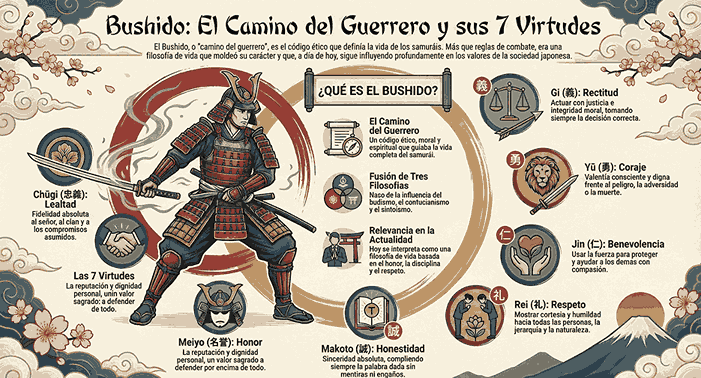
The Virtues of Bushido: The Values of the True Samurai
Bushidō is often summed up in seven fundamental virtues. These defined the ideal character of a samurai, an ethic that governed both his sword and his daily life.
- Rectitude (Gi): to act justly, with a sense of what is right; make fair decisions even when they are difficult. Righteousness implied moral integrity and consistency.
- Courage (Yū): courage in the face of danger, adversity or death. Not impulsive courage, but conscious courage, with dignity, courage with honor.
- Benevolence/Compassion (Jin): to use force, not to oppress, but to protect, to help the weak. A samurai had to have compassion, humanity, sensitivity.
- Respect/Courtesy (Rei): respect for others, for hierarchy, for life, for nature. Courtesy, humility, dignity.
- Honesty / Sincerity (Makoto): absolute sincerity. To tell the truth, to keep one’s word. Not lies, not deception; Honesty as a way of life.
- Honor (Meiyo): personal reputation, dignity. Honor was sacred: to maintain it, to defend it even in the face of death, rather than to live in dishonor.
- Loyalty (Chūgi): fidelity to the Lord, to the clan, to duty, to the commitments assumed. Absolute loyalty, even at the cost of one’s own life.
These virtues were not written as inflexible laws, but were part of a samurai’s spiritual, moral, and social formation: they forged his character, his sense of duty, and his way of seeing the world.
Bushido in Modern Japanese Culture
Their presence at work, ethics, and daily life
Although Japan has been radically transformed since the feudal era, many of the values of Bushidō are still present in everyday life. Dedication to work, responsibility, punctuality, respect, the search for perfection, humility, a sense of duty; All of these traits have roots in samurai ethics.
Professionals, artisans, athletes, students, companies – some adopt that spirit of effort, discipline, excellence, commitment. The Bushidō functions as an ideal of life: not by the sword, but by personal honor, by dignity, by coherence.
How it appears in anime, film and literature
Bushidō’s legacy has strongly influenced popular culture. In literature, cinema, manga, anime or modern martial arts, samurai ideals are still valid: characters who fight for justice, for honor, for loyalty; stories of sacrifice, redemption, honor and duty.
Even today, modern works recover those values to explore internal conflicts, ethical dilemmas, personal growth, sacrifice, morality. Bushidō transcends history: it remains a symbolic language, an archetype of life, universal inspiration.
Why is it still important to understand Bushido today?
What it teaches Japanese learners and culture lovers
For those who learn Japanese or are interested in Japan, Bushidō offers a key to understanding the Japanese mentality, values, and cultural sensitivity. It is not just history: it is a living philosophy that explains certain collective attitudes, rules of coexistence, respect, humility, discipline. Getting to know Bushidō helps to understand why courtesy, diligence, dedication, and quiet excellence are so highly valued in Japan.
In addition, Bushidō offers universal lessons: integrity, honor, responsibility, loyalty, bravery. Principles valid in any era or culture. Adopting them can be a personal ethical guide.
Lessons That Still Influence Japanese Society
Through generations, Bushidō shaped Japanese identity: influence on modern martial arts, on the moral code, on work ethics, on interpersonal treatment. Their legacy is noticeable in education, in social relationships, in respect for others, in the search for constant improvement.
For many Japanese, Bushidō remains a symbolic reference – a reminder of the past, of values, of dignity – that transcends history and adapts to modernity.
Explore more Japanese culture while living in Japan
If you’re interested in truly immersing yourself in Japanese culture—not just learning vocabulary or grammar, but understanding its soul, its philosophy, its history—we invite you to do so with us at Doki Doki Japan. Understanding Bushidō does not mean becoming a samurai, but it does mean approaching a different way of seeing life: with honor, with respect, with responsibility, with values.
You may be interested in: reflecting on how those principles can inspire your day-to-day life, whether you’re studying Japanese or simply looking for ethical guidance. We’re with you on that journey: history, context, culture, real life — no swords, but with all the depth.

Co-founder and Director of Doki Doki Japan. After learning Japanese and working in Japan for two years, he decided to turn his passion for teaching into a vision: to found his own online Japanese language school.


