
What is Kansai-ben and where is it spoken?
The term Kansai-ben (関西弁) refers to the set of dialects spoken in the Kansai region, also known as the Kinki region, in western Japan. It includes prefectures and emblematic cities such as Osaka, Kyoto, Kobe, among others.
Although standard Japanese (Hyōjungo) is also understood and used in Kansai, Kansai-ben retains a strong identity: for many people in the region, it is more than just a way of speaking—it is part of their regional culture and identity.
Kansai and its prefectures: Osaka, Kyoto, Kobe, and more
The Kansai region includes several prefectures and urban areas: Osaka, Kyoto, Hyōgo (where Kobe is located), Nara, Shiga, Wakayama, among others. Each retains features of Kansai-ben, albeit with local variations.
Differences Between Standard Japanese (Hyōjungo) and Kansai-ben
While standard Japanese—typically learned in Japanese schools and used in national media—has relatively neutral pronunciation, normative grammar, and standardized vocabulary, Kansai-ben is distinguished by: stronger intonation, distinct vocabulary, alternate verb endings, changes in particles, and a more relaxed, expressive, and colloquial style.
Do you want to discover the spirit of Omotenashi without leaving home?
With Doki FLIX, learn Japanese online while exploring the culture, values, and traditions that make Japanese hospitality unique. Live classes, cultural workshops and much more.
Origin and History of the Kansai Dialect
Cultural and humorous influence
The origin of Kansai-ben can be traced back to the ancient cultural and historical centers of Japan: when the ancient capitals were in Kyoto or Nara, the dialect spoken in that area—the predecessor of modern Kansai-ben—was practically the country’s standard.
With the passage of time and the rise of Edo/Tokyo as a political center, the standard Japanese we know today began to be based on the Eastern dialect. Meanwhile, in the Kansai region the dialect evolved to retain its own features, developing an identity separate from “official Japanese”.
In addition, Kansai’s reputation as a warm, direct, and humorous area—especially notable in traditional Japanese comedy (manzai) or television—helped cement the dialect as a symbol of regional character: expressive, lively, colloquial.
Kansai in Japanese anime, television, and comedy
It is no coincidence that many popular comedians, actors, and comedians in Japan hail from Osaka—their speech and character have helped to familiarize Kansai-ben throughout Japan. This media exposure has made his intonation, expressions and humor associated with spontaneity, sympathy and regional warmth.
In anime, manga, or entertainment shows, when a character wears Kansai-ben, they are usually portrayed as outgoing, mischievous, or funny, which also helps to understand their social and cultural use.
Features of the Kansai-ben that make it unique
Pronunciation and intonation
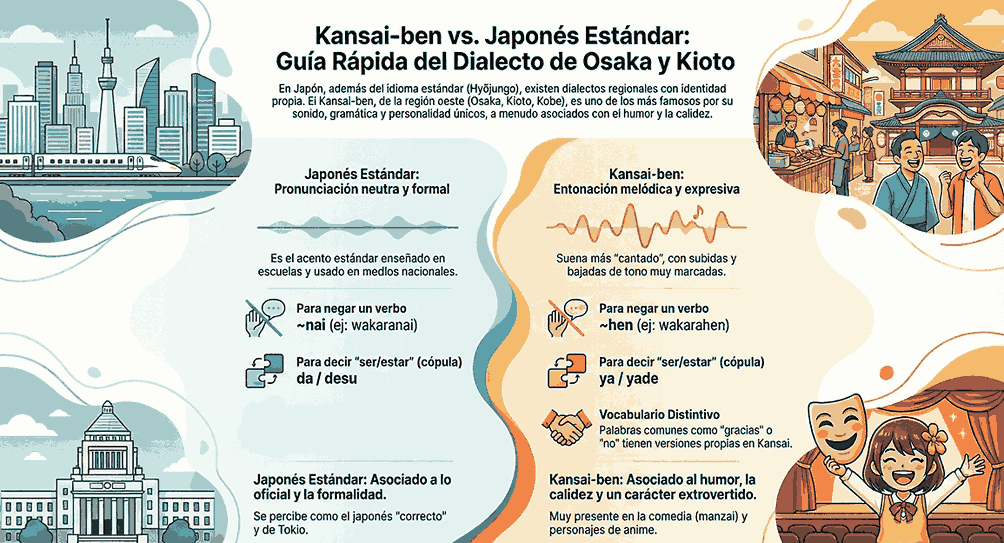
One of the most obvious differences between Kansai-ben and standard Japanese is musicality: its accent tends to be more melodic, with more marked rises and falls in pitch, making the way of speaking sound more “sung” or expressive.
In addition, some vowels retain their full sound (in contrast to the vowel reduction tendency of standard Japanese), which also contributes to that “lively intonation” feeling.
Typical grammar and particles
Kansai-ben has notable grammatical variations from standard Japanese. For example:
- Instead of the common negative form with –nai (~ない), Kansai-ben uses –hen (~へん) or –n (~ん).
- The copula “ser/estar” changes: what in the standard is da or desu, in Kansai-ben is usually ya or yade, particularly in colloquial speech.
- In some areas, respectful endings more particular to the dialect may be used, or idioms specific to each subregion.
Frequent Kansai-ben words and expressions
The vocabulary also changes: common phrases in standard Japanese can be replaced with distinctive expressions of the Kansai. For example—and although it may vary between cities—the nuances of “no,” “very,” “what/how much,” or “thank you” can be expressed in ways that are different from the standard.
That repertoire makes listening to or speaking Kansai-ben instantly recognizable and loaded with local identity.
Is Kansai dialect hard to learn?
Advantages and challenges for Japanese learners
Learning Kansai-ben can be a very enriching experience: it opens the door to real Japanese, the everyday language of millions of people in Kansai, and allows you to grasp cultural nuances, local humor, and a closer form of expression. Also, if you plan to visit, live, or work in Kansai, it can be a great plus to socialize.
However, it has its challenges: intonation, different endings, colloquial vocabulary… All of this can confuse those who are used to standard Japanese. Many times, even those who are fluent in the “formal” language express that when they hear Kansai-ben for the first time, it seems like another language.
When it is useful to learn this dialect
- If you are going to live, study or work in Kansai (Osaka, Kyoto, Kobe…).
- If you’re interested in Japanese pop culture — comedy, anime, manga, TV — where Kansai-ben has a strong presence.
- If you want to connect more authentically with locals: using your own vocabulary and intonation can help you build empathy and sympathy.
- If you are interested in the history of the language: understanding how dialects coexist with Standard Japanese will give you a more complete view of the language.
How to Practice Kansai-ben: Resources, Series, and Tips
- Living or spending time in the Kansai region: It’s the most direct way to absorb the dialect — by listening to it and using it in real context.
- Listen to comedy, shows, anime, or media from Kansai — they often use this dialect naturally.
- Study specific vocabulary and grammar: Many dialect guides include lists of expressions, different conjugations, and comparative examples with Hyōjungo.
- Practice with native speakers: If you talk to Kansai people, even if it’s an “arigatō” or a simple phrase in dialect, it can help adapt to their rhythm and intonation.
Learn more about Japanese and regional culture with Doki Doki Japan
If you are fascinated by the idea of immersing yourself in one of the most authentic and vibrant faces of the Japanese language, we invite you to explore with us: at Doki Doki Japan we offer resources, classes and specialized content to understand – not only understand – but live real Japanese, in all its regional diversity. Learn Kansai-ben, discover its cultural nuances, and gain a richer look at the real Japan.

Co-founder and CEO of Doki Doki Japan. After studying Japanese in Japan between 2017 and 2019, he founded this school with the aim of offering accessible and authentic education to students who want to learn Japanese.