
“Golden Week” is like a magical parenthesis in the Japanese routine: a succession of national holidays that transforms the entire country into a gigantic stage of rest, travel and celebration. If you are wondering what it really means, how it is lived, and what you should know if you happen to be in Japan during those days… I kept reading.
What is Golden Week in Japan and why is it so important?
Golden Week (ゴールデンウィーク, Gōruden Wīku) is an annual holiday that groups four national holidays in close proximity on the calendar, allowing many people to take several consecutive days off.
Would you like to experience Golden Week and other Japanese traditions from the inside?
If your dream is to learn Japanese in Japan, at Doki Doki Japan we accompany you to choose the ideal school for you. Study the language, live the culture and discover the country beyond tourism.
The four holidays that make up Golden Week
These are the key days that make up Golden Week:
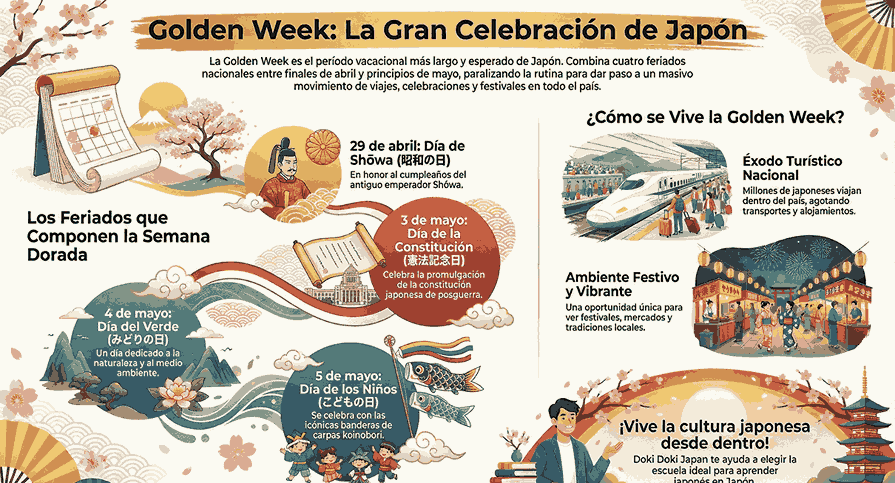
- April 29 — Shōwa no Hi (Shōwa Day): originally celebrated Emperor Shōwa’s birthday.
- May 3 — Kenpō Kinenbi (Constitution Day): Commemorates the promulgation of Japan’s post-war constitution.
- May 4 — Midori no Hi (Green Day/Nature): dedicated to nature and the environment.
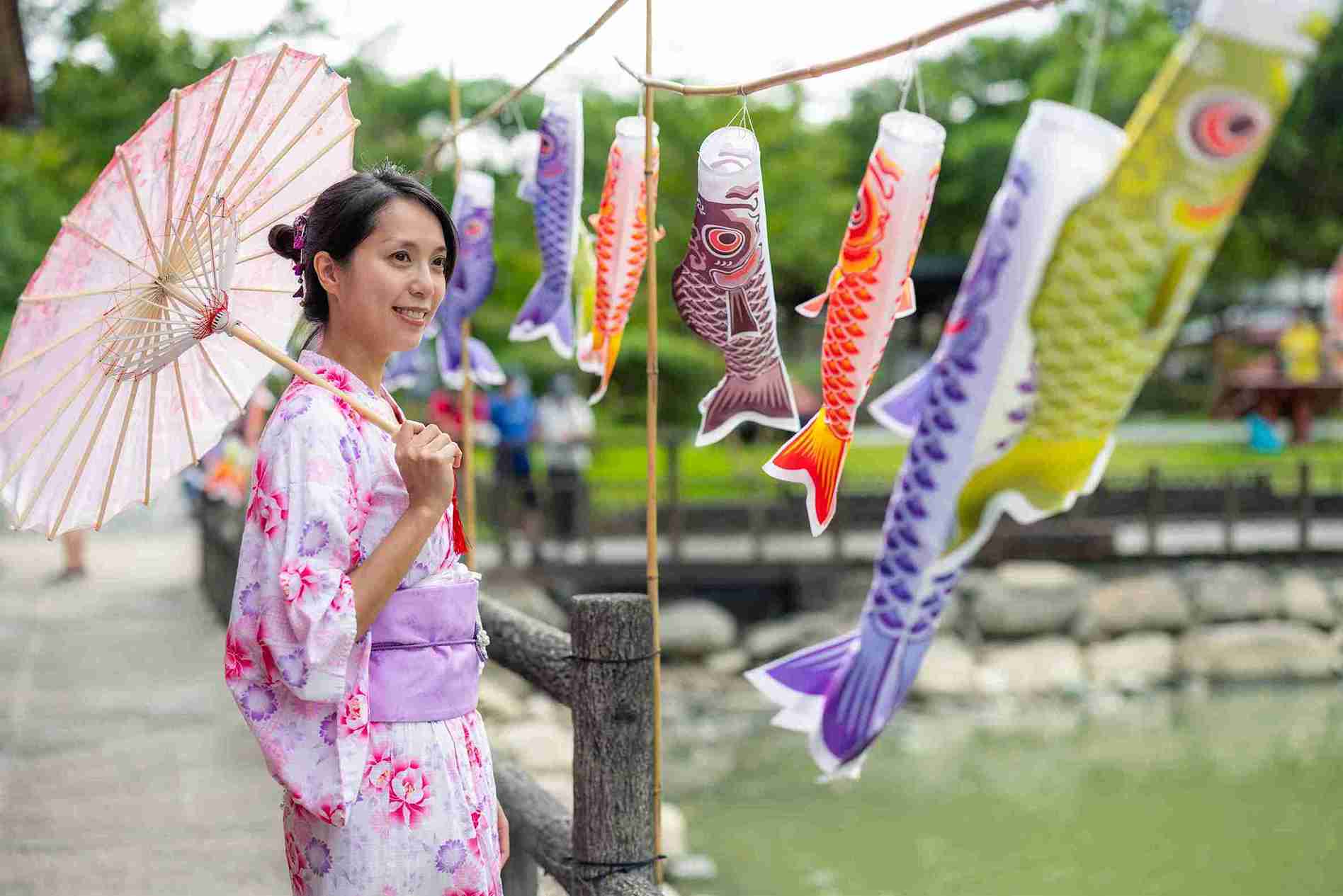
- May 5 — Kodomo no Hi (Children’s Day): A holiday that celebrates children’s health and happiness — with traditional decorations such as “koinobori” (tent-shaped flags).
Duration and dates of Golden Week in Japan
Although Golden Week officially runs from April 29 to May 5, many times weekends and “bridge” holidays extend the holidays: it is common for some people to enjoy between 7 and 10 days in a row. This makes Golden Week the longest — and most anticipated — holiday season of the year for much of the country.
For this reason, many daily activities stop, offices and schools close, and a domestic exodus begins to tourist destinations, rural towns, coastal areas or natural areas.
The historical origin of Golden Week and its evolution
From commercial strategy to national tradition
Golden Week has modern roots: after the enactment of the public holiday law in 1948, several holidays were very close in the calendar, allowing for the combination of days off. This proximity generated an ideal context for collective rest and encouraged the demand for leisure, entertainment and tourism.
In the 1950s, the film industry – and entertainment in general – began to notice very high audience peaks during those days. This is how the term “Golden Week” was born, inspired by the Japanese expression “golden time” (the moment of greatest audience or affluence), to describe that explosive period of demand. Over time, the name was consolidated and the week of vacation became part of the Japanese social imaginary.
How it's celebrated today
Today Golden Week is synonymous with rest, indoor tourism, family reunions, festivals, getaways and cultural or outdoor activities. Many families take the opportunity to return to their hometown, go sightseeing, visit parks or temples, go out to nature or rediscover corners of the country that they do not normally visit. It is a time of disconnection, union, and social renewal.
What happens in Japan during Golden Week?
Travel, domestic tourism and large crowds
During Golden Week, domestic tourism skyrockets. Shinkansen trains, domestic flights, buses, hotels, and ryokan fill up—often months in advance—on popular routes such as Tokyo-Kyoto-Osaka, to beaches, rural destinations, or tourist areas. Accommodations sell out fast and prices skyrocket.
For those who plan to travel on these dates, it is advisable to book in advance and have flexibility, because demand often exceeds supply.
Typical events, festivals and activities
In addition to travel, many localities organize festivals, markets, fairs, outdoor activities, and traditional events: processions, concerts, shows, ceremonies, celebrations in temples, cultural activities or rural tourism. It is an opportunity to see Japan vibrant, full of life, traditions and contrasts.
For a visitor, this means an intense experience: seeing “koinobori” flags decorating houses, crowded temples, people in parks, lots of activities, colorful… but also many crowds.
Impact on Retail, Transportation, and Utilities
The tourism boom increases the demand for transport, accommodation, restaurants, shops and tourist services. At the same time, many offices, companies and shops close because the same population takes the opportunity to go on holiday. This can complicate some services, paperwork or bookings if they are not planned in advance.
Cities are crowded, there are long lines, heavy traffic, risk of running out of seats in hotels or trains, and prices tend to rise. For many travelers, this environment requires patience, organization, and flexibility.
Tips for traveling during Golden Week
What to expect if you're visiting Japan at this time of year
- Crowds in transportation (train, plane, bus), airports, stations, and tourist destinations.
- High prices for accommodation, transportation, entrance fees — often well above the usual.
- Crowds in tourist attractions, parks, temples, popular areas.
- A festive, vibrant and energetic atmosphere: ideal for those who want to experience Japan intensely, with local atmosphere, festivities, urban and cultural life.
Alternatives to avoid the crowds
If you want to avoid the stress of Golden Week:
- Plan to travel before or just after Golden Week, avoiding peak days.
- Opt for less touristy destinations: rural areas, lesser-known islands, little-visited prefectures: lower prices, fewer crowds, and a quieter experience.
- Choose activities out of the ordinary: nature, small towns, mountains, coasts, alternate routes, rural or cultural experiences of your own, rather than just the most popular tourist landmarks.
Recommendations for booking transport and accommodation
- Book everything well in advance (bullet train, accommodation, internal flights, local transport).
- If you’re going to visit multiple cities, consider using alternative transportation or off-the-beaten-path routes.
- Be flexible with dates and destinations: adjusting to availability can make the difference between a good experience or total chaos.
Is it a good idea to study or live in Japan during Golden Week?
How Japanese students experience it
For those studying Japanese or living in Japan, Golden Week often represents a welcome break: many schools close or pause, allowing you to travel, rest, explore the country, or just relax. It can also be the perfect opportunity to get to know other prefectures or take the opportunity for cultural immersion.
What closes and what remains available
Some administrative services, offices, banks or institutions may close, so if you need to do paperwork, it is advisable to plan them in advance. On the other hand, transport, accommodation, tourist space, shops focused on tourism and leisure usually operate – although with saturation – some with even greater demand than in normal season.
For those who live there, it can be a period of contrast: urban emptiness in certain areas, but also cities full of tourists, families celebrating, festivals, street atmosphere, etc.
Experience Golden Week with the eyes of an explorer
Golden Week is not just a holiday: it is a social, cultural and popular phenomenon that transforms Japan. It’s a time when the country pauses its usual rhythm to connect with history, family, nature, travel, traditions, and community. For those who live it – whether as Japanese or visitors – it can be an intense, enriching, fun experience… or chaotic, if not well planned.
If you’re thinking of being in Japan during Golden Week, it can be an unforgettable experience… As long as you book early, choose your destinations wisely, adapt and maintain realistic expectations.
And if you want to accompany that trip with an extra plus – learning Japanese, understanding the culture, festivities, customs and behaviors – at Doki Doki Japan we will help you truly immerse yourself in the experience.

Co-founder and Director of Doki Doki Japan. After learning Japanese and working in Japan for two years, he decided to turn his passion for teaching into a vision: to found his own online Japanese language school.